

I N S U R A N C E

Why You Should Review Your Insurance Every Year

Insurance is not something you buy once and forget. Your life changes every year—income grows, responsibilities increase, assets expand, and risks evolve. That’s why an insurance review is essential to ensure your protection keeps up with your needs. Yet, many people in India continue their policies without conducting an annual insurance check, leaving gaps in coverage that may only become visible during a claim. If you want to stay financially secure, understanding the importance of annual insurance review is the first step.

What Is an Insurance Policy Review?

An insurance policy review is the process of evaluating your existing policies to check whether they still match your current financial situation, lifestyle, and risk exposure. It involves checking your coverage limits, benefits, add-ons, exclusions, and premium costs.

In India, insurance regulations and product features are regularly updated. Conducting an insurance coverage update ensures your policy aligns with the latest offerings and your evolving needs.

Why Review Insurance Policy Every Year?

Many people ask, why review insurance policy every year? The answer is simple because your life is constantly changing.

An annual review helps you:

  • Identify gaps in coverage
  • Adjust your sum insured
  • Add or remove riders
  • Ensure cost-effectiveness
  • Stay compliant with updated policy terms

Without reviewing your policy, you may be underinsured or paying for benefits you no longer need.

How Often Should You Review Insurance Plans?

A common question is, how often should you review insurance plans? Experts recommend conducting an annual insurance review at least once a year or after major life events such as:

  • Marriage
  • Birth of a child
  • Buying a home
  • Job or income change
  • Starting a business

Regular reviews help you stay protected against both expected and unexpected risks.

Key Areas to Check During Insurance Review

If you’re wondering how to review insurance coverage annually, here’s a simple checklist:

1. Coverage Adequacy

Check if your current coverage is enough. Rising medical costs and property values in India mean you may need a higher sum insured.

2. Policy Benefits and Add-Ons

Evaluate if your policy includes relevant riders. For example, health insurance may need critical illness cover or cashless benefits.

3. Premium vs Value

Ensure you are getting value for your premium. Compare your existing plan with new market options.

4. Exclusions and Waiting Periods

Review policy exclusions carefully to avoid surprises during claims.

5. Claim Process Efficiency

Understand the insurer’s claim settlement process and ratio.

This insurance policy update checklist helps you make informed decisions.

Importance of Reviewing Health Insurance Every Year

Healthcare costs in India are rising rapidly. That’s why it’s crucial to review health insurance policy every year. You should check:

  • Hospital network and cashless facilities
  • Coverage for modern treatments
  • Waiting periods for pre-existing diseases
  • Adequacy of sum insured

If your coverage hasn’t increased over time, it may not be enough to handle current medical expenses.

When Should You Update Your Insurance Policy?

Another important question is, when should you update your insurance policy? Apart from annual reviews, you should update your plan when:

  • Your income increases significantly
  • You acquire new assets
  • Your family size grows
  • Your financial responsibilities change

Timely insurance coverage update ensures you’re always protected against new risks.

Check If Your Insurance Coverage Is Enough

One of the biggest mistakes people make is assuming their old policy is sufficient. You must regularly check if your insurance coverage is enough based on:

  • Inflation
  • Lifestyle changes
  • New liabilities
  • Market conditions

For example, a ₹5 lakh health insurance policy that was sufficient five years ago may not be enough today.

Benefits of Annual Insurance Review

Understanding annual insurance review benefits can help you stay proactive:

  • Avoid underinsurance
  • Optimize premium costs
  • Improve claim success chances
  • Stay updated with new features
  • Enhance overall financial planning

An updated insurance plan ensures your financial safety net remains strong.

How to Improve Insurance Coverage Over Time

If you’re wondering how to improve insurance coverage over time, consider:

  • Increasing sum insured periodically
  • Adding relevant riders
  • Switching to better plans
  • Combining policies for better coverage
  • Consulting experts for guidance

Continuous improvement ensures your protection grows with your life.

Insurance Planning in India: A Continuous Process

In India, insurance planning should not be treated as a one-time task. Regulatory updates, new product launches, and changing personal needs require ongoing evaluation.

Whether it’s health, life, motor, or home insurance, conducting a review insurance policy exercise every year keeps your financial protection aligned with reality.

How Insurance Guru Helps You Stay Updated

At Insurance Guru, we believe insurance should evolve with your life. Our expert advisors help you:

  • Conduct a complete insurance coverage check
  • Compare plans and benefits
  • Identify gaps and risks
  • Recommend cost-effective solutions
  • Ensure smooth claim support

With Insurance Guru, your insurance is not just active—it’s optimized.

Final Thoughts

Insurance is your financial safety net—but only if it’s up to date. An annual insurance policy review ensures your coverage remains relevant, sufficient, and effective.

Don’t wait for a claim to discover gaps in your policy. Take time for an annual insurance check, understand the importance of annual insurance review, and make necessary updates.

With the right approach—and expert support from Insurance Guru you can stay protected, confident, and financially secure every year.

FAQs

During an insurance review, check your coverage amount, policy benefits, add-ons, exclusions, and premium costs. Also review claim settlement ratios and whether your current insurer meets your needs. This helps you identify gaps and ensures your policy provides adequate protection.

It is recommended to review your insurance plans at least once a year. You should also review them after major life events like marriage, childbirth, job changes, or purchasing property to ensure your coverage remains relevant.

Yes, you can update your insurance policy during renewal or when your insurer allows changes. You can increase coverage, add riders, or switch plans based on your evolving needs and financial goals.

Insurance Guru helps you analyze your current policies, identify coverage gaps, compare better plans, and recommend the right updates. Their expert guidance ensures you stay fully protected without overpaying.


The Future of Insurance in India: What’s Changing in 2026?

The insurance landscape in India is undergoing a powerful transformation. What once relied heavily on paperwork, long approval timelines, and limited customization is now evolving into a tech-driven, customer-centric ecosystem. As we move into 2026, the future of insurance in India is being shaped by digital innovation, regulatory reforms, artificial intelligence, and changing consumer expectations.

From buying policies online in minutes to receiving faster claim settlements, the insurance industry is stepping into a new era. Let’s explore the key changes, insurance trends 2026, and what they mean for individuals, families, and businesses across India—with insights from Insurance Guru.

1. Digital Insurance Is Becoming the New Normal

One of the most visible changes in recent years has been the rise of digital insurance India. By 2026, most insurance journeys—from policy purchase to claim settlement—will be fully digital.

Customers no longer want lengthy forms or physical documentation. They expect instant quotes, digital policy issuance, online renewals, and app-based claim tracking. Insurers are investing heavily in mobile apps, customer portals, and digital dashboards to deliver seamless experiences.

For consumers, this means:

  • Faster policy buying

  • Transparent policy details

  • Reduced paperwork

  • Real-time claim updates

This shift is redefining trust and convenience in the insurance ecosystem.

2. Insurance Industry Transformation Through Technology

The broader insurance industry transformation is being driven by technology adoption at every level. Traditional insurers are modernizing their systems, while new digital-first companies are challenging conventional models.

Automation, cloud computing, data analytics, and APIs are helping insurers:

  • Process policies faster

  • Reduce operational costs

  • Improve customer service

  • Detect fraud more efficiently

In 2026, insurers that fail to adapt to this transformation risk losing relevance in a highly competitive market.

3. AI in Insurance India: Smarter Decisions, Faster Claims

One of the most impactful changes shaping the future is AI in insurance India. Artificial intelligence is no longer experimental—it’s becoming central to underwriting, pricing, and claims.

AI-powered systems are now used to:

  • Assess risk more accurately

  • Predict claim probabilities

  • Detect fraudulent claims

  • Automate claim approvals

For policyholders, AI means quicker claim settlements and more personalized pricing. For insurers, it means better risk management and lower losses. As AI matures further by 2026, its role in insurance decision-making will only expand.

4. Insurtech Growth India Is Reshaping the Market

The rapid insurtech growth India has brought innovation, speed, and transparency into the sector. Insurtech startups are using technology to simplify complex insurance products and improve accessibility.

These companies focus on:

  • User-friendly platforms

  • Simplified policy language

  • Instant customer support

  • Digital-first claims

Traditional insurers are now collaborating with or acquiring insurtech firms to stay competitive. This collaboration is expected to intensify by 2026, blending trust with innovation.

5. New Insurance Regulations India Are Strengthening the System

Another major factor shaping the future is new insurance regulations India. Regulators are actively working to improve consumer protection, encourage competition, and promote innovation.

Key regulatory changes focus on:

  • Faster claim settlement norms

  • Improved grievance redressal

  • Transparent policy disclosures

  • Encouraging digital adoption

These reforms aim to create a more stable, fair, and customer-friendly insurance environment. By 2026, regulations will further support digital insurance growth while ensuring policyholder interests remain protected.

6. Customized Insurance Plans Are Replacing One-Size-Fits-All

Modern customers want insurance that fits their lifestyle—not generic policies. This demand is driving the rise of customized insurance plans.

In 2026, insurers will increasingly offer:

  • Modular policies

  • Add-on covers based on need

  • Usage-based insurance

  • Flexible premium options

For example, customers can choose only the covers they need—whether it’s health, home, travel, liability, or cyber protection—making insurance more relevant and affordable.

7. Paperless Insurance Process Is the New Standard

The paperless insurance process is becoming standard practice across India. Physical documents, manual forms, and branch visits are being replaced by digital signatures, e-KYC, and online verification.

Benefits of paperless insurance include:

  • Faster onboarding

  • Lower processing errors

  • Environment-friendly operations

  • Easy access to policy records

By 2026, paperless insurance will not just be an option—it will be the expectation.

8. Emerging Insurance Technologies Are Driving Innovation

Several emerging insurance technologies are redefining how insurers operate and serve customers. These include:

  • Blockchain for transparent records

  • Internet of Things (IoT) for real-time risk monitoring

  • Telematics for usage-based motor insurance

  • Big data analytics for customer insights

These technologies help insurers design better products, reduce fraud, and improve claim accuracy—creating a more reliable insurance ecosystem.

9. Changing Consumer Mindset in 2026

Indian consumers are becoming more aware, informed, and proactive about insurance. They now:

  • Compare policies online

  • Read reviews before buying

  • Expect quick service

  • Demand transparency

This shift is forcing insurers to prioritize customer education, clear communication, and value-driven offerings. The future of insurance is not just about selling policies—but about building long-term trust.

10. How Insurance Guru Helps You Stay Future-Ready

As insurance continues to evolve, having the right guidance becomes more important than ever. Insurance Guru helps individuals and businesses navigate this changing landscape with confidence.

With expert advice, updated knowledge of insurance trends 2026, and access to modern insurance solutions, Insurance Guru ensures customers choose policies that are relevant today—and future-ready for 2026 and beyond.

From understanding digital policies to selecting customized insurance plans, Insurance Guru acts as a trusted partner in your insurance journey.

Final Thoughts

The future of insurance in India is digital, intelligent, and customer-focused. As we move into 2026, technology, regulation, and innovation will continue to reshape how insurance is bought, managed, and experienced.

From AI in insurance India to insurtech growth India, and from paperless insurance processes to customized insurance plans, the industry is evolving rapidly. Staying informed and choosing the right guidance will make all the difference.

With Insurance Guru, you can stay ahead of these changes—secure, informed, and confidently protected in the new era of insurance.

Step-by-Step Guide to Filing an Insurance Claim Smoothly

Step-by-Step Guide to Filing an Insurance Claim Smoothly

Submitting a claim with an insurance company can be stressful particularly when you are in the moment of a disaster whether it be an accident, health crisis, or a loss to your property. Knowing the process will make the experience of a claim a lot easier! Ultimately, the best way to protect your insurance contract is to be prepared and informed with all aspects of the claims process.

In this guide, we will give you a step-by-step guide about the process of filing a claim with your general insurance provider, so you are confident to manage it effectively.


Why does it matter to file an insurance claim properly?

When you make a purchase, you are buying financial protection, but that protection does not work if your insurance claims are not filed properly or on time. A properly documented claim will provide:

  •  Faster insurance payments.
  •  Fewer issues with your insurer.
  •  Peace of mind that your insurance coverage is being used for its intended purpose.

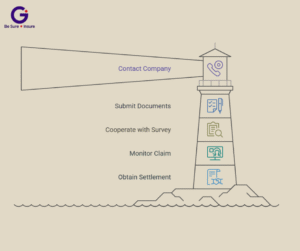
Step 1. Reviewing your insurance policy.

Prior to pursuing the actual claim, it is valuable to read your insurance policy closely. Understanding your coverage, exclusions and limitations is beneficial for avoiding disappointment later.

👉 Pro Tip: When possible, ensure to have a copy of your insurance information (policy, contact information and claims form) for any emergency.

Step 2: Contact Your Insurance Company Right Away

Contact your property insurer to report the loss as soon as possible. This will start the insurance process in a timely manner and keep your process from being delayed, due to you not notifying them in a timely manner.

Most companies offer several ways to file a claim: 

  • by phone
  • by email or online claim form
  • via mobile app

Step 3: Gather and Submit Required Documents

Documentation is the backbone of a successful insurance claim. Depending on the type of claim (health, motor, home, etc.), you may need:

  • Policy document
  • Claim form (filled and signed)
  • Identity proof
  • Bills, receipts, or medical records
  • FIR (in case of theft/accident)
  • Photographs of damage

👉 Missing documents are one of the most common reasons for claim rejection.


Step 4: Cooperate During the Survey or Investigation

For many claims, the insurance company will assign a surveyor or investigator to assess the situation. Be honest, cooperative, and provide all requested insurance information.

  • For health insurance: medical reports and hospital bills may be verified
  • For motor insurance: vehicle inspection is usually conducted
  • For property insurance: damage assessment is performed


Step 5: Monitor Your Claim and Follow Up

Once you’ve submitted your claim it’s important to stay proactive. Use your insurer’s online client portal or call their helpline to check the status of a claim. You should follow-up with them periodically so that your claim isn’t stalled. 

👉 If it’s likely you will run into trouble with getting paid, then it’s worthwhile to speak with a trusted advisor like Insurance Guru to help the claims process along.

Step 6: Obtain Your Settlement

Once approved, the settlement will be processed by an insurance company. Depending on what type of a policy you have, this could be:

  • Cashless settlement (the money goes directly to the hospital/garage)
  • Reimbursement (you pay for the services upfront). 

Common Mistakes to Avoid During an Insurance Claim

  • Delaying claim intimation to your insurer
  • Submitting incomplete documents
  • Misrepresenting facts in the claim form
  • Ignoring small print in your insurance policy

Avoiding these mistakes ensures faster approval and minimizes disputes.

Why Choose an Insurance Guru for Your Claims Process to be Easy?

Here at Insurance Guru led by Rahul Handa (Certified Insurance Broker), we are dedicated to making the claims process easy for all our clients here in Mohali and the rest of Punjab. We have more than 15 years’ experience of guiding you through each step, ensuring:

  • Understanding of your Insurance Policy.
  • Help with the preparation of documents that are accurately completed.
  • Follow up with the claims regarding nothing unnecessary.
  • Assuring you that you have taken all the benefit from your Insurance Policy.


Final Thoughts

The claims process does not need to be complicated. Insurance Claims can be made stress free through being informed and keeping organized, and being proactive to help get your insurance settlement. If you need an expert in insurance in Mohali, contact Insurance Guru today.